
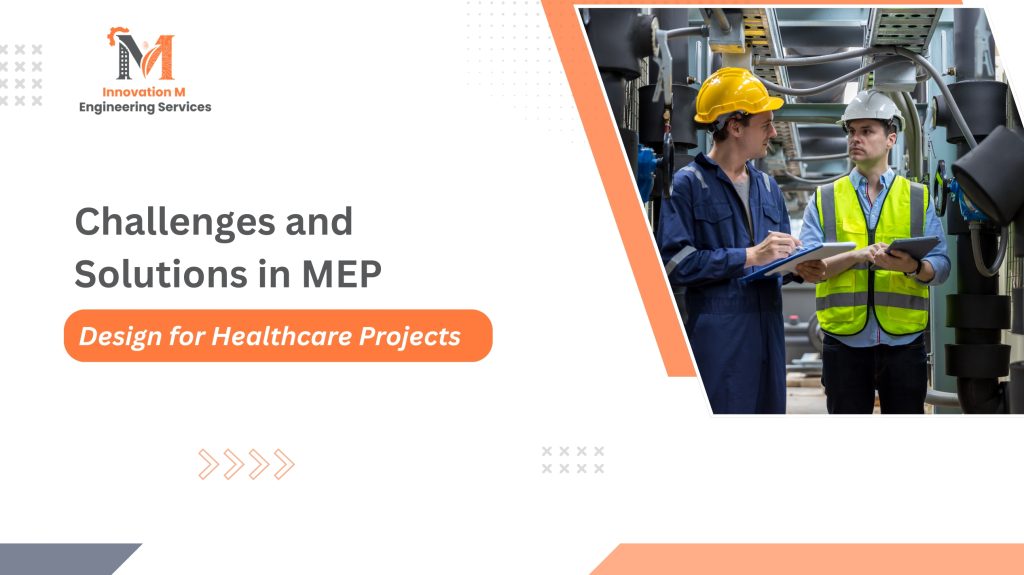
In the high-stakes world of medical infrastructure, the accuracy of MEP Design for the Healthcare sector can be the difference between a successful recovery center and a facility upset by repeated operational failures. As of 2026, the global healthcare MEP services market is estimated to reach a valuation of around $169.83 billion (Fortune Business Insights, 2026), driven by a pressing requirement for smarter, more resilient healing environments. Unlike the past, modern hospitals are no longer just buildings; in fact, they are complex, data-driven ecosystems where life-saving equipment and infection control protocols rely wholly on unified mechanical, electrical, and plumbing integration. Innovation M Engineering Services (IMES) distinguishes this critical intersection, presenting world-class consulting and engineering services that bridge the gap between sophisticated physical infrastructure and secure private cloud data organization.
The Critical Importance of MEP Design for the Healthcare Sector
When we discuss MEP Design for the Healthcare industry, we are looking at the core life-support systems of a building. In a standard hospital, MEP systems account for around 40% of total construction costs (WSP, 2026), reflecting the complexity of specialized wants like medical gas distribution and ultra-fine air filtration. Healthcare facilities are not like commercial offices and as these facilities never sleep; therefore, they require 100% uptime and fail-safe redundancy.
A specialized MEP consulting firm realizes that healthcare design is not one-size-fits-all. Different zones from sterile operating theaters to high-traffic outpatient clinics demand exclusive atmospheric conditions. IMS leverages its expertise to guarantee these systems are not only robust but also digitally combined, positioning itself as a leader among MEP design consultants by delivering “cloud-ready” engineering that enable real-time system monitoring and predictive maintenance.
Core Challenges in Hospital Engineering
The path to a successful medical facility is fraught with technical barriers. Hospital engineering should account for invisible threats, like Antimicrobial Resistance (AMR) pathogens that can travel through plumbing and ventilation systems. Recent studies suggest that hospital-associated infections can double the risk of mortality and add an average of $18,588 per infection in additional costs to US hospitals (HIS, 2025).
Key challenges faced by MEP engineering services for healthcare comprise:
- Strict Infection Control: Designing HVAC systems that apply HEPA filtration and negative pressure zones to stop the cross-contamination of airborne diseases.
- System Redundancy: Ensuring that a “Single Point of Failure” does not exist, principally in critical care units (ICUs) where power or oxygen loss is catastrophic.
- Spatial Constraints: Managing the “clash” of vast ductwork, electrical conduits, and plumbing lines within the tight ceiling plenums of modern medical wings.
- High Energy Demand: Balancing the 24/7 operational requirements of a hospital with global sustainability requirements and rising energy prices.

Solutions Provided by Expert MEP Design Consultants
To overcome these barriers, businesses must hire environmental design expert teams who can execute advanced technological solutions. The incorporation of Building Information Modeling (BIM) has set a standard that’s non-negotiable. Adoption of this combination has been rising by 20% over the last three years to improve design accuracy and collaboration (Business Research Insights, 2026).
Through our consulting and engineering services, IMS delivers targeted solutions:
- Advanced Clash Detection: Using AI-driven BIM tools to resolve spatial clashes before they reach the construction site, saving weeks of rework.
- Modular MEP Systems: Applying prefabricated utility racks that can be installed up to 25% faster than traditional on-site assembly.
- Smart Lighting and HVAC: Realizing IoT-enabled sensors that adjust environment settings based on room occupancy, decreasing waste without negotiating on patient comfort.
- Resilient Power Architectures: Designing rotating Uninterruptible Power Supply (UPS) systems that provide immediate backup while diesel generators kick in.
By opting direct hire engineering staff from a specialized firm like IMS, healthcare providers gain approach to a talent pool specifically trained in these high-accuracy medical protocols.
Integrating Private Cloud for Smarter Healthcare MEP
As a trusted private cloud provider, IMS recognizes that modern hospital engineering yields vast amounts of data. From temperature logs in pharmacies to pressure sensors in isolation rooms, this data should be stored and analyzed securely. A private cloud environment confirms that sensitive facility data remains isolated from public threats while remaining available to maintenance teams via secure VPNs.
This “Digital Twin” approach enables MEP Design for the Healthcare projects to step beyond reactive repairs. Engineers can simulate “what-if” scenarios like a power grid failure or a localized outbreak for testing the facility’s response in a virtual environment before a crisis happens. This is the characteristic of a truly modern engineered solution.
Benefits of Partnering with a Top-Tier MEP Consulting Firm
Partnering with an established MEP consulting firm like Innovation M Engineering Services means that you gain more than just technical drawings; you get peace of mind. Our MEP engineering services for healthcare are devised to maximize the lifecycle of your assets while guaranteeing patient safety is never a variable.
Key Features of Our Service:
- 24/7 Monitoring Integration: Every MEP system we design is efficient for full integration with our private cloud for distant diagnostics.
- Regulatory Expertise: Deep knowledge of FDA, WHO, and local building codes make sure that your facility is compliant from day one.
- Cost-Benefit Analysis: We present detailed ROI projections on energy-saving technologies such as copper-silver ionization for water safety.
- Agile Staffing: Our capacity to provide direct hire engineering staff guarantees you have the right experts on-site for the duration of your project.
Sustainable MEP Design for the Healthcare Future
Sustainability should not be considered an “extra” item; it is a core part of MEP Design for the Healthcare sector. With global mandates inducing net-zero carbon footprints, hospitals are seeking ways to recycle graywater and use on-site renewable energy. IMS incorporates these green technologies into our consulting and engineering services, serving hospitals for reducing their environmental impact while cutting long-term operational expenses.
Statistics exhibit that smart building systems can decrease a healthcare facility’s energy consumption by up to 20% to 30% (Technavio, 2026). This is succeeded through high-efficiency heat recovery chillers and intelligent water management systems that stop stagnation and the growth of waterborne pathogens such as Legionella.
Conclusion: Lead the Future of Healthcare with IMS
The difficulties of modern MEP Design for the Healthcare sector require a partner who looks beyond the blueprint. Innovation M Engineering Services (IMES), a subsidiary of Innovation M Services, brings an exceptional blend of technical mastery and digital security to every project. Whether your requirement is to hire environmental design expert talent or you need a full-suite MEP consulting firm to manage a multi-phase hospital expansion, our team provides excellence that scales.
By adding our consulting and engineering services with a secure private cloud backbone, we guarantee your healthcare facility is not just built for today but engineered for the future. Experience the difference of a partnership where data-driven visions meet structural integrity.