
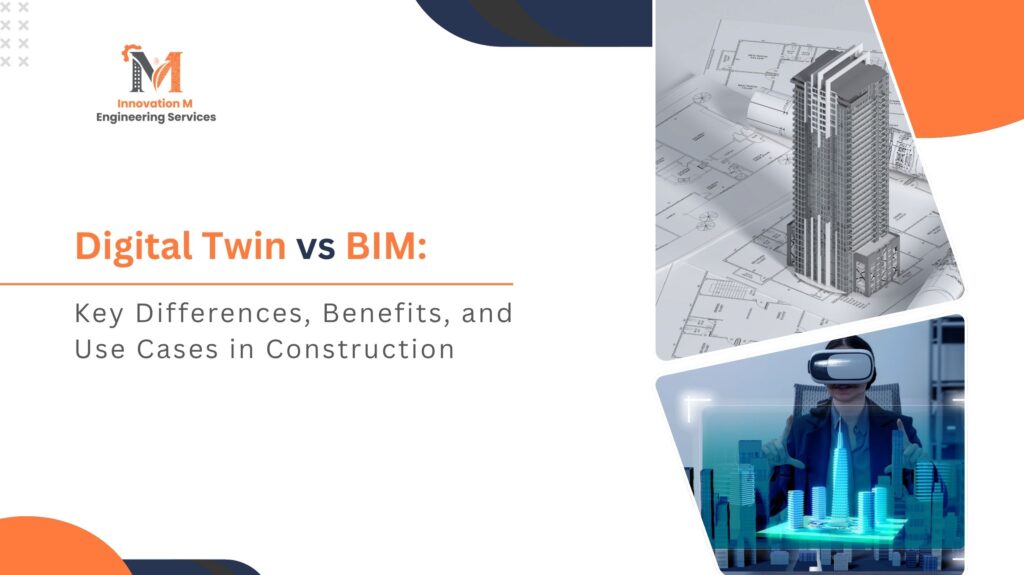
This article educates construction industry related individuals and companies on the basic difference between BIM and digital twin. Both have their own benefits and uses. It also provides information on use of the two tools.
Static drawings have become obsolete in modern construction, which is proceeding toward intelligent models, linked assets, IoT data, and lifecycle-based decision-making. The real question For AEC firms that are comparing digital twin vs BIM, is not which technology sounds more developed. The real question is which one solves the project’s present problem. McKinsey informed that global construction output reached almost $13 trillion in 2023, while Autodesk and FMI realized that in 2020 poor project data may have resulted in loss of $1.85 trillion in global construction which could be avoided. These figures emphasize why better digital workflows now matter.
Both BIM and digital twins support smarter construction, but in different phases of the project as follows:
- BIM assists teams design, coordinate, document, and build projects more efficiently.
- Digital twins apply that information into real-time monitoring, operations, maintenance, and long-term asset performance.
Understanding Digital Twin vs BIM
The comparison of digital twin vs BIM starts with purpose. BIM, or Building Information Modeling, is a model-based process that is used to plan, design, coordinate, document, and manage project information during design and construction. A digital twin is a dynamic digital representation of a physical asset that can link with live or updated operational data.
BIM often provides the basis for a digital twin, but the two are not the same. BIM is mostly focused on design, construction coordination, documentation, clash detection, and handover. A digital twin runs into operations, performance monitoring, maintenance planning, asset management, and lifecycle decisions.
Why the Difference Matters
Misunderstanding the difference can result in poor technology planning. A firm may invest in a BIM model but fail to describe asset data, sensor integration, maintenance workflows, or operating dashboards. In that case, the model may still support construction but may not develop as a true digital twin.
Common Confusion in AEC Teams
Many AEC teams regard any 3D BIM model as a digital twin, while a true digital twin typically involves:
- Updated asset data,
- LoT integration,
- Operational systems,
- Performance monitoring,
- Lifecycle information management.
Rapid Selection Tip
When the priority is design coordination, clash detection, documentation, and construction planning, use BIM, while a digital twin is used when the priority is live monitoring, facility operations, predictive maintenance, and long-term asset performance.
What Is BIM in Construction?
BIM is a digital process that establishes intelligent models containing geometry, quantities, schedules, materials, systems, and project information. It helps architects, engineers, contractors, consultants, and owners work from coordinated information rather han disconnected drawings.
BIM supports design review, clash recognition, quantity takeoff, construction sequencing, documentation extraction, and as-built model handover. It is most valuable when numerous disciplines have to coordinate before construction starts.
Benefits of BIM
BIM helps project teams to enhance communication and decrease design uncertainty. It empowers teams to visualize spaces, review conflicts, and renew documentation from coordinated models.
Key benefits comprise:
- Enhanced design coordination
- Helpful visualization for stakeholders
- Early clash recognition before construction
- More consistent drawings and schedules
- Easier quantity takeoff and cost planning
- Useful support for construction sequencing
- Effective asset information at handover
These benefits make BIM a strong initial point for firms that want to enhance project delivery, decrease rework, and prepare better information for owners.
What Is a Digital Twin in Construction?
Many owners and contractors are interested to know what is a digital twin in construction because this term is now widely used in digital transformation discussions. A digital twin in construction is a digital depiction of a building, facility, infrastructure asset, or system that can be linked with real-time or regularly updated operational data.
It may bring together BIM models, IoT sensors, building management systems, energy data, maintenance records, asset registers, inspection information, and analytics platforms. The goal is not only to see the asset, but to know how it functions.
How a Construction Digital Twin Works
A construction digital twin links a physical asset with digital information. Sensors and operational systems may provide data on occupancy, temperature, energy use, equipment performance, air quality, structural behavior, water systems, or maintenance status, making it highly valuable for BIM services for infrastructure projects by supporting better planning, monitoring, coordination, and asset management.
This lets owners and operators make decisions based on real asset performance. Teams can monitor conditions, detect patterns, and plan maintenance more intelligently rather than waiting for a fault to occur,.
From Design Model to Operational Twin
A digital twin often starts with BIM data. However, it becomes more beneficial when the model is enriched with equipment tags, asset classifications, sensor links, maintenance schedules, system relationships, and operational dashboards.
Practical Examples
- A hospital may use a digital twin for monitoring HVAC equipment, room conditions, energy performance, and critical facility systems.
- A bridge may use sensors for tracking structural behavior and maintenance requirements.
- A water facility may use a digital twin for monitoring pumps, flow conditions, and asset performance.
Building 3D Digital Twin: What It Includes
A building 3D digital twin may incorporate architectural, structural, MEP, and facility-management information. It can display spaces, rooms, equipment, systems, assets, sensors, and performance data in a visual digital environment.
For facility managers, a building 3D digital twin can enhance visibility of building systems. It can facilitate teams locating assets, review maintenance information, monitor equipment condition, and recognize how building systems interact.
Main Components of a Building 3D Digital Twin
A complete digital twin depends on data quality and clear operative goals. Common components comprise:
- Perfect BIM or 3D model
- Asset information and equipment tags
- IoT sensor data or operational annals
- Building management system addition
- Data of maintenance and inspection
- Dashboards and analytics tools
- Security and data governance standards
The model is only helpful if the information behind it is trustworthy. A visually attractive 3D model without clean data will not provide full digital twin value.
BIM vs Digital Twin: Main Differences
The digital twin vs BIM comparison becomes clearer when the project stage, data type, and users are contemplated. BIM is mostly created during design and construction. Digital twins are frequently used during operations and asset management.
BIM is model-centered, while digital twins are data-connected and performance-centered. BIM facilitates create the asset. A digital twin facilitates managing the asset after it exists.
Comparison Table
Category | BIM | Digital Twin |
|---|---|---|
Main Purpose | Design and construction coordination | Operations and asset performance |
Data Type | Model geometry and project information | Live, updated, and operational data |
Main Users | Designers, contractors, consultants | Owners, operators, facility managers |
Project Stage | Design, construction, handover | Operation, maintenance, lifecycle |
Technology Link | BIM software and coordination tools | BIM, IoT, analytics, BMS, AI |
Best Use | Clash detection and documentation | Monitoring, optimization, maintenance |
Both technologies can collaborate when data needs are planned early. The strongest results usually come when BIM models are established with future operational use in mind.
Use Cases of BIM in Construction
BIM is extensively used during planning, design, coordination, and construction. It helps teams decrease coordination gaps before site work starts.
General BIM use cases include:
- Architectural and structural coordination
- MEP clash recognition
- Quantity takeoff
- Construction sequencing
- Shop drawing support
- Design review and visualization
- As-built model handover
BIM is a lot the better initial point for firms that need better coordination during design and construction. It establishes structured information that may later support a digital twin.
Use Cases of Digital Twins in Construction and Operations
A construction digital twin becomes more beneficial when the asset moves from construction into operation. It helps with monitoring, maintenance, performance analysis, and lifecycle planning.
Digital twin use cases are energy monitoring, predictive maintenance, facility management, safety review, occupancy analysis, infrastructure monitoring, equipment performance tracking, and smart city planning.
Examples by Project Type
Digital twins can support many asset types, which are:
- Commercial buildings
- Hospitals and airports
- Industrial facilities
- Bridges and transport infrastructure
- Water and utility assets
- Smart campuses and cities
A digital twin becomes remarkably valuable when the owner demands long-term visibility, operational efficiency, maintenance planning, and performance monitoring.
Benefits of Digital Twin Technology
Digital twins enhance asset visibility and facilitate owners making better operational decisions. They relate design information with actual asset behavior.
Important benefits comprise:
- Reliable visibility of real asset performance
- Enhanced preventive and predictive maintenance
- More informed operational decisions
- Decreased downtime and maintenance risk
- Effective energy and sustainability management
- Better facility and asset lifecycle planning
Digital twins are most effective when they are supported by correct models, clean data, defined asset information requirements, and clear operational goals.
Digital Twin vs BIM for Project Efficiency
The digital twin vs BIM decision also depends on how efficiency is measured. BIM enhances efficiency during design and construction by improving coordination, decreasing clashes, and making better documentation. Digital twins improve efficiency during operation by supporting monitoring, maintenance forecasting, asset planning, and performance optimization.
Autodesk and FMI reported that 16% of all construction rework globally in 2020 was due to bad project data. Deloitte’s 2026 Engineering and Construction Outlook also emphasize continuing labor pressure in engineering and construction, showing why better digital workflows are becoming more important.
How BIM Improves Project Delivery
BIM enhances project delivery through model coordination, clash detection, design review, drawing extraction, quantity information, and construction sequencing.
It facilitates teams recognizing issues before construction and supports better communication between consultants, contractors, and owners.
How Digital Twins Improve Operations
Digital twins improve operations through asset monitoring, maintenance prediction, energy performance review, space management, system optimization, and lifecycle planning.
They facilitate owners move from reactive maintenance to more informed operational decision-making.
When Should Firms Hire Dedicated BIM Modelers?
Firms may hire dedicated BIM modelers when they require model creation, clash coordination, documentation extraction, family creation, as-built modeling, quantity takeoff support, or BIM deliverables.
Dedicated BIM modelers help enhance model quality and decrease pressure on internal teams. They are particularly useful when projects have strict BIM requirements or complex multidisciplinary coordination.
Signs BIM Support Is Required
A firm may require BIM support when:
- Projects need BIM deliverables
- Coordination issues are growing
- MEP conflicts are delaying work
- Internal teams are overloaded
- As-built models are obligatory
- Client standards need BIM documentation
Companies should hire dedicated BIM modelers when model quality, coordination, and documentation consistency are vital to delivery.
When Should Firms Hire AI Digital Twin Developers?
Firms may hire ai digital twin developers when they require IoT integration, dashboard development, data analytics, predictive maintenance workflows, AI-driven asset monitoring, or advanced facility-management platforms.
Digital twin development demands more than modeling. It joins AEC knowledge, data engineering, cloud systems, software development, analytics, and asset management understanding.
Skills to Look for in AI Digital Twin Developers
Important skill areas involve:
- BIM and 3D model integration
- IoT data integration
- Cloud platforms and databases
- AI and machine learning analytics
- Dashboard and visualization tools
- Asset management workflows
- Cybersecurity and data governance
A firm should hire ai digital twin developers when it wants a linked operational system, not just a static visual model.
How to Choose Between BIM Support and Digital Twin Support
The best choice is established with the project objective. If the goal is design coordination, BIM support may be sufficient. If the goal is operational monitoring and lifecycle performance, digital twin support may be necessary.
Questions to Ask Before Hiring
Helpful questions include:
- Is the project in design, construction, or operation?
- Are BIM deliverables needed by the client?
- Is live operational data desired?
- Are IoT sensors or BMS systems involved?
- User of the final model or platform?
- What asset data should be maintained after handover?
- Does the firm require modelers, developers, or both?
Data Readiness Checklist
Before starting a digital twin project, firms should examine existing BIM models, asset registers, sensor systems, maintenance records, naming standards, and data governance. Strong data preparation decreases later integration problems.
Hiring Tip for AEC Leaders
The right partner should comprehend both AEC workflows and digital technologies. A digital twin is not just a 3D model. It is a linked operational system.
How IMES Supports BIM and Digital Twin Workflows
IMES provides support to clients with BIM modeling, as-built modeling, building 3d digital twin preparation, asset data structuring, digital engineering coordination, and construction digital twin workflows.
The company can support firms looking for architectural BIM modeling services outsourcing, dedicated BIM modelers, AI digital twin developers, or practical digital workflows for design, construction, operations, and asset management.
Conclusion
IMES is a staunch engineering, BIM, and digital twin support partner for companies that require BIM modeling, construction digital twin workflows, building 3D digital twin preparation, and proficient digital engineering resources. The digital twin vs BIM comparison does not imply choosing one technology forever. BIM provides help to teams for design, coordinate, document, and construct projects more efficiently. A digital twin takes that information into operations, monitoring, maintenance, and lifecycle asset management.
Firms should review their BIM maturity, estimate asset data needs, and contact IMES to select the right support model for better coordination, operations, and project performance.