

For decades, engineers and designers have trusted on the flat screen the 2D viewport, or at best, the constrained 3D model for visualizing complex structures and products. This traditional approach often results in significant errors in spatial understanding, poor ergonomics, and slow communication. Presently, however, the game is changing, with the seamless fusion of design and immersion. The incorporation of Virtual Reality CAD design is the technological leap that allows users to step inside their models, closing the gap between the digital concept and physical reality. Innovation M Engineering Services (IMES) provides the expert 3D CAD drafting services needed to generate these high-fidelity models, while its parent company, Innovation M Services (IMS), supplies specialized software development services and infrastructure to make these immersive experiences possible.
Moving Beyond the Screen: Understanding Virtual Reality CAD Design
Virtual Reality CAD design is not just viewing a 3D model on a large monitor; it is the process of interpreting complex computer-aided design (CAD) files into a fully interactive, stereoscopic environment where users experience the design at true scale. The core difference is great: VR CAD design enables users to inhabit the model, walking through a mechanical assembly or a proposed facility, rather than just rotating it with a mouse.
The workflow starts with expert 3D CAD drafting services provided by IMES, generating the precise digital geometry. This file is then improved for the 3D CAD VR environment. Optimization is a critical high-polygon count CAD model must be cleaned and prepared so that the Virtual Reality CAD software can render the model smoothly at the high frame rates which are required for comfortable immersion.
Key Immersive Capabilities of VR CAD Modeling
- Scale Validation: Immediately confirm that components are sized correctly, eliminating the guesswork of interpreting dimensions on a 2D drawing.
- Ergonomics and Access Testing: Physically crouch, reach, and move around equipment or maintenance zones to test clearances and human factors before fabrication starts.
- Material and Lighting Inspection: Experience the visual effect of proposed materials, textures, and lighting schemes in a realistic virtual environment.
- Assembly Sequence Planning: Walk through a complex installation or maintenance task, detecting potential pitfalls or sequencing errors.
Advantages of Implementing CAD Design in VR for Smarter Projects
The adoption of CAD with VR yields substantial benefits that transcend mere visualization, leading to greater precision, accelerated workflows, and improved project outcomes.
Core Benefits to Engineering and Collaboration
Virtual Reality CAD design drastically improves communication among multidisciplinary teams and clients by making the design intuitive.
- Reduced Design Iterations: Errors in spatial relationships, clearances, and human factors are found and corrected quickly in the immersive environment, cutting down the number of expensive design cycles.
- Minimized Downstream Errors: When teams experience the design in VR, they catch structural or mechanical conflicts that might otherwise be missed until the physical building, saving considerable time and cost during construction.
- Accelerated Client Sign-off: Clients who can walk through and grasp a design intuitively are more likely to approve it quickly, rationalizing the approval phase.
- Enhanced Ergonomics Analysis: Designers can rapidly optimize control panel layouts, operator views, and workflow paths, ensuring the final product is safer and more efficient to use.
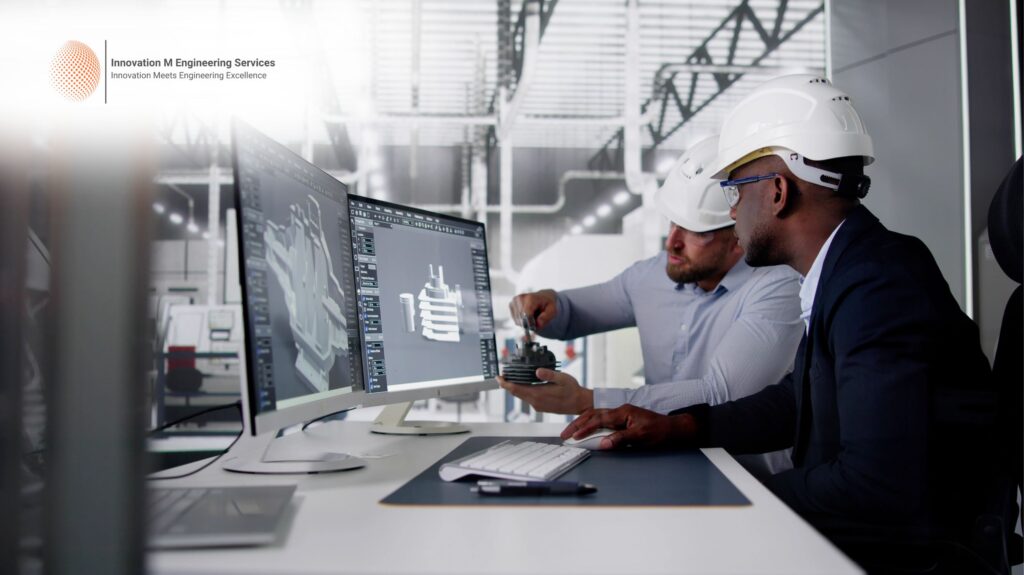
- Superior Multidisciplinary Coordination: Engineers from different disciplines (e.g., mechanical, electrical, architectural) can conduct real-time design reviews together by using specialized Virtual Reality CAD software, ensuring seamless incorporation of their work.
Ready to minimize design errors and accelerate approvals? Consult with IMES for your next Virtual Reality CAD design project and transform your workflow.
The IMES-IMS Edge in Providing End-to-End VR CAD Modeling Solutions
Delivering high-quality, seamless CAD design in VR expects a perfect marriage of high-precision engineering and cutting-edge software technology. This end-to-end expertise is exactly what the partnership between IMES and IMS provides.
IMS: Software Development and Cloud Infrastructure
Innovation M Services (IMS) is a trusted private cloud provider and leader in software development services which makes the immersive experience possible. IMS’s role is crucial in:
- Custom Software Development: IMS develops or customizes Virtual Reality CAD software tools and connectors, enabling complex CAD data to be efficiently streamed to VR headsets.
- Secure Cloud Hosting: The IMS private cloud delivers the safe, high-performance infrastructure necessary for streaming large 3D CAD VR files to users globally. This assures low-latency, real-time collaboration without compromising the security of proprietary design data.
- Multi-User Environment: IMS provides software development services to manage synchronal, multi-user VR sessions, empowering geographically dispersed teams to meet and work together on the same model simultaneously.
IMES: Expert Engineering and Execution
Innovation M Engineering Services offers the foundational engineering services and technical mastery that is required for accurate and efficient VR CAD modeling.
- High-Precision 3D CAD Drafting Services: We ensure that the source CAD models are built with the highest geometric integrity and data standards, which is paramount for realistic VR conversion.
- CAD-to-VR File Optimization: Our engineering services team specializes in optimizing, cleaning, and texturing CAD data to ensure smooth performance within the VR environment while protecting design integrity.
- Implementation of Review Protocols: IMES supports clients establish clear, effective collaborative protocols for using CAD with VR during design review, maximizing the efficiency of the immersive sessions.
- Integration with Project Systems: We ensure that the VR workflow combines seamlessly with existing PLM (Product Lifecycle Management) and other project management systems.
Conclusion: Stop Guessing, Start Experiencing
The shift to Virtual Reality CAD design is a defining moment for modern engineering. It replaces uncertainty with clarity, decreases costly physical prototypes, and fosters truly collaborative design. By providing expert engineering services and high-fidelity 3D CAD drafting services, IMES assures design precision and performance. This is all empowered by IMS, which delivers the specialized software development services and safe private cloud infrastructure necessary for a seamless, immersive experience.
Stop guessing, start experiencing. Contact IMES today to integrate Virtual Reality CAD design into your next high-stakes project and secure a smarter, more accurate outcome.