

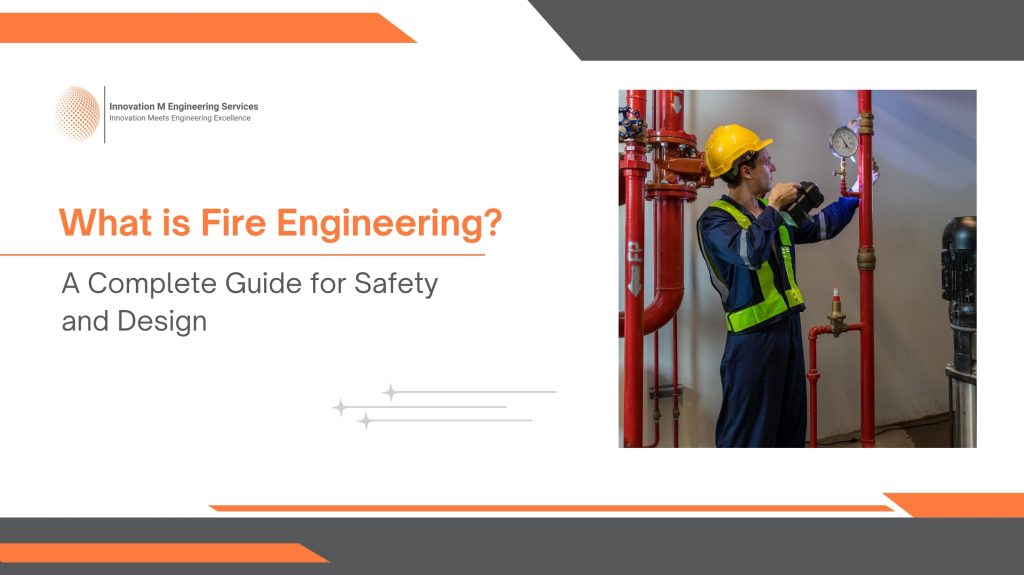
Modern buildings are towering, denser, and more complex than ever before. According to global safety studies, the reasons for fire losses in a large percentage of structures fire are either poorly designed systems or they were not integrated with building layout. This is why many developers and authorities are gradually asking a fundamental question: What Fire Engineering is and how it protects lives, assets, and infrastructure. Fire engineering is a scientific tactic to forecast fire behavior and design buildings so that occupants can evacuate safely while structures remain secure long enough for emergency response.
Identification of this discipline is necessary for architects, project managers, and facility owners who require safety and compliance without surrendering design flexibility.
What is Fire Engineering?
Fire engineering is a specialized engineering discipline that is focused on analyzing fire behavior and planning systems that control its impact. Instead of trusting only on standard code rules, engineers assess real building conditions like geometry, materials, ventilation, and occupancy patterns.
The goal is simple: guarantee that people escape safely and stop catastrophic structural collapse.
Conventional design follows prescriptive rules, i.e. for example fixed stair widths or sprinkler spacing. Fire engineering uses performance-based analysis to establish whether the building actually performs safely under fire conditions.
Practically, this discipline decides:
- How fast does a fire grow?
- How does smoke spread through space?
- How long can a structure withstand heat?
- How long do evacuation routes remain usable?
Because modern architecture contains atriums, open spaces, and underground facilities, scientific analysis is often the only consistent way to guarantee safety.
What is a Fire Engineer?
Many professionals ask ‘what a fire engineer’ is and how the role is different than general safety consultants. A fire engineer is a technical expert who studies heat transfer, combustion, and human evacuation behavior to design safety approaches.
The role links engineering, physics, and building design knowledge. Rather than installing equipment only, the engineer decides how systems interact during emergencies.
Responsibilities usually include:
- Calculating building layouts for evacuation safety
- Designing smoke control and recognition systems
- Confirming compliance with regulations
- Simulating fire scenarios
Their work affects both safety and architecture. Without this proficiency, projects often become overdesigned, costly, or rejected by authorities.

Key Aspects of Fire Engineering
Fire engineering covers numerous technical areas that run together. Each aspect guarantees a building performs predictably during emergencies.
Fire behavior is analyzed utilizing heat release rates and material properties. Smoke movement is studied because smoke results in most fire-related fatalities. Structural resistance decides how long occupants have to evacuate. Recognition and suppression systems control the fire before its spread.
Essential technical areas include:
- Fire dynamics and heat growth
- Smoke movement and ventilation behavior
- Evacuation and occupancy movement
- Structural resistance to high temperature
- Active suppression systems
These aspects are assessed together rather than independently. A safe building depends on system interaction, and not individual components.
What Fire Engineers Do?
Fire engineers contribute throughout the project lifecycle. Their involvement starts during concept planning and persists through approvals and construction.
During design stages they review layouts and find potential hazards. Later they confirm installation and provide certification support.
Standard workflow includes:
- Beginning risk assessment
- Concept safety approach
- Detailed modeling and computations
- Support for authority approval
- Construction inspection review
This continuous involvement stops late design changes that delay construction.
Role of Fire Prevention and Protection Engineer in Modern Projects
A fire prevention and protection engineer acts closely with architects, structural teams, and mechanical engineers. Coordination makes certain that safety measures do not conflict with architectural intent.
For example, smoke exhaust systems should align with HVAC layouts. Exit routes should match occupant flow patterns. Structural fire ratings should match material selection.
By incorporating safety early, projects sustain design freedom while achieving compliance. This coordination prevents avoidable equipment installation and decreases operational complexity.
Fire Protection Engineering Consultants and Services
Many developers trust fire protection engineering consultants to confirm design decisions before approval submission. These experts provide analytical verification instead of standard checklists.
Fire protection engineering services usually include:
- Modeling of fire and smoke simulation
- Analysis of evacuation time
- Code compliance confirmation
- Documentation on risk assessment
The benefit is clarity. Authorities receive considerable proof of safety rather than assumptions. Approval processes become quicker and more predictable.
Engineered Solution vs Prescriptive Codes
Prescriptive codes indicate fixed values such as stair width or sprinkler coverage. These rules work well for simple buildings but limit innovative architecture.
An engineered solution estimates performance rather than strict dimensions. Engineers exhibit that occupants can evacuate safely even if the building layout is different from traditional designs.
This approach enables:
- Larger open spaces
- Optimized material use
- Adaptable architectural concepts
- Cost-efficient safety approaches
Performance-based design often decreases avoidable construction cost while continuing safety standards.
When Projects Need Direct Hire Engineering Staff
Large or complex developments often need constant safety evaluation. In such cases organizations engage direct hire engineering staff that is dedicated to fire engineering coordination.
Dedicated experts become valuable when projects include:
- High-rise buildings
- Transport hubs
- Hospitals or data centers
- Industrial facilities
Continuous engagement guarantees design consistency and simplifies communication with regulators.
Benefits of Professional Fire Protection Engineering Services
Professional analysis develops safety while controlling project cost.
Key benefits include:
- Decreased risk to occupants
- Quicker regulatory approval
- Enhanced system installation
- Improved building usability
- Minimal lifecycle cost
These benefits occur because decisions are based on performance data instead of assumptions. Projects succeed compliance without overdesign.

Conclusion
Fire safety today involves scientific analysis rather than relying solely on prescriptive rules. Buildings must operate safely under real-world conditions, not just theoretical scenarios. Innovation M Engineering Services delivers performance-based fire safety solutions backed by coordinated digital engineering environments, enabling developers to achieve compliance while preserving architectural intent.
Through integrated engineering management services, the team ensures seamless collaboration between fire protection, structural, MEP, and design disciplines. This strategic oversight strengthens risk assessment, streamlines regulatory approvals, and optimizes project execution—creating safer, smarter, and more resilient built environments.