

Digital tools play a critical role in shaping the way buildings and infrastructure are designed, developed, and delivered in today’s construction and engineering world. Out of many, there are two tools (BIM and CAD) which are most widely discussed. Both tools, i.e. BIM and CAD, have their own purpose, advantages, and challenges. A thorough knowledge about BIM vs CAD is crucial for architects, engineers, and project managers who want to choose the right tool for their projects.
Both tools have changed the way we work. CAD, or Computer-Aided Design, transformed drafting by replacing manual drawings with digital designs. BIM, or Building Information Modeling, takes things further advance by adding layers of intelligence, data, and collaboration to the design process. The evaluation of CAD vs BIM difference is not just about knowing technology alone, it’s about how each tool influences efficiency, communication, and project success.
This article discovers BIM vs CAD in construction, identifying what is the difference between CAD and BIM, answers an important question like: BIM vs CAD, which is better for commercial construction? In the end, you’ll have a clear knowledge of both systems and how Innovation M Engineering Services can help you decide which is right for your project.
What is CAD?
Since the 1960s, CAD, short for Computer-Aided Design, has been a keystone of engineering and design. Before CAD, engineers and architects depended on hand-drawn blueprints, which were not only time-consuming, but they were also prone to errors. CAD changed everything by enabling precise, scalable, and editable designs to be created on a computer.
In construction and engineering services, CAD is often used for:
- 2D drawings such as floor plans, elevations, and sections.
- 3D modeling for visualization.
- Drafting of mechanical and electrical layouts.
- Design of infrastructure and manufacturing components.
The strength of CAD lies in its accuracy and awareness. Almost every engineer and architect has worked with CAD at some point in their career, making it a widely adopted standard across industries.
What is BIM?
BIM, or Building Information Modeling, is a more recent innovation that has more features than CAD’s capabilities. BIM creates an intelligent digital model of a building or infrastructure project, instead of just producing drawings. This model doesn’t just show how a project looks like; in addition, it also contains data about materials, specifications, quantities, and even the life-cycle performance of systems.
BIM empowers all project stakeholders i.e. from architects and engineers to contractors and facility managers to work together on a single shared model. Changes made by one discipline are automatically reproduced across the project, thus reducing errors and improving coordination.
In short, while CAD is just a design tool, while BIM is a collaborative process supported by digital technology that integrates design, construction, and operation into one intelligent workflow.
CAD vs BIM Difference
The CAD vs BIM difference can be summarized as follows:
- CAD: It focuses on drawing and drafting, creating precise 2D or 3D representations of designs.
- BIM: It focuses on modeling and collaboration. Drawing is just one part of BIM; it also includes data and intelligence that help manage the project throughout its life cycle.
In practice:
- CAD is good for detailed drafting of mechanical parts or simple floor plans.
- BIM is ideal for large, complex projects that require input from multiple disciplines.
This distinction clears why many engineering services firms now use both CAD and BIM depending on the project scope.
BIM vs CAD in Construction
When we start comparing BIM vs CAD in construction, the biggest difference we see lies in collaboration and project efficiency. Though CAD allows engineers to create drawings, but coordination frequently requires manual checking between teams. BIM, on the other hand, empowers real-time collaboration within a single shared model.
For example, if the HVAC engineer designs a duct in BIM, the architect and structural engineer can immediately see if it clashes with a beam or wall. In CAD, such coordination would demand separate drawings and manual reviews, which may delay the project and increase the risk of errors.
In construction, 4D (time scheduling) and 5D (cost management) modeling are also supported by BIM, thus making it a powerful tool for project planning and execution.
BIM vs CAD: Which Is Better for Commercial Construction?
One of the most commonly asked questions is: BIM vs CAD, which is better for commercial construction?
The answer lies in project complexity. For smaller projects, CAD may be appropriate, particularly if the design requirements are simple. However, for large-scale commercial projects such as shopping malls, office towers, hospitals, and airports, BIM offers undisputable advantages:
- Improved coordination between disciplines.
- Reduced clashes and rework during construction.
- Better cost control through accurate quantity take-offs.
- Enhanced scheduling with 4D and 5D BIM capabilities.
- Easier facility management after construction is completed.
Although for commercial construction, BIM is generally the greater choice, but CAD still plays a role in detailing certain specific components or producing shop drawings.
What is the Difference Between CAD and BIM?
In simple words: CAD is about lines and shapes; BIM is about objects and data.
- In CAD, a wall drawing shows just two lines while in BIM, a wall is shown as a digital object with thickness, material, thermal properties, and cost.
- In CAD, schedules and material quantities are calculated manually while in BIM, they are produced automatically from the model.
- CAD drawings are static while BIM models are dynamic and updated in real time.
This is why many professionals designate BIM as a “smarter” version of CAD. Although CAD is still valuable, BIM signifies the future of construction design and management. The following table depicts the differences between CAD and BIM in more explicit way.
Feature / Aspect | CAD (Computer-Aided Design) | BIM (Building Information Modeling) |
|---|---|---|
Focus | Drafting and drawing | Modeling and collaboration |
Representation | Lines, shapes, and geometry | Intelligent objects with data |
Output | 2D drawings & 3D models | Integrated digital model (3D/4D/5D) |
Data Integration | Minimal – mainly geometry | Extensive – includes materials, costs, scheduling, performance |
Collaboration | Limited – requires manual updates | High – real-time updates across all disciplines |
Use Case | Small-scale projects, components, shop drawings | Large-scale projects, complex buildings, lifecycle management |
Error Detection | Manual clash checks | Automated clash detection via BIM tools |
Project Phases Supported | Design & drafting | Design, construction, and operations |
Cost Management | Separate process | Built-in with 5D BIM |
Facility Management | Not supported | Supported – data used after construction |
Best For | Simple design tasks, component detailing | Complex commercial, institutional, industrial and infrastructure projects |
Adoption in Engineering Services
The adoption of BIM vs CAD in engineering services is not just a simple matter of one tool replacing the other; instead, most firms including Innovation M Engineering Services have strategically combined both, using them where they deliver the most value. This balanced approach is necessary to address the diverse nature of engineering projects, where some tasks require the familiarity and speed of CAD, while others demand the advanced collaboration and intelligence of BIM.
How CAD is Still Widely Used
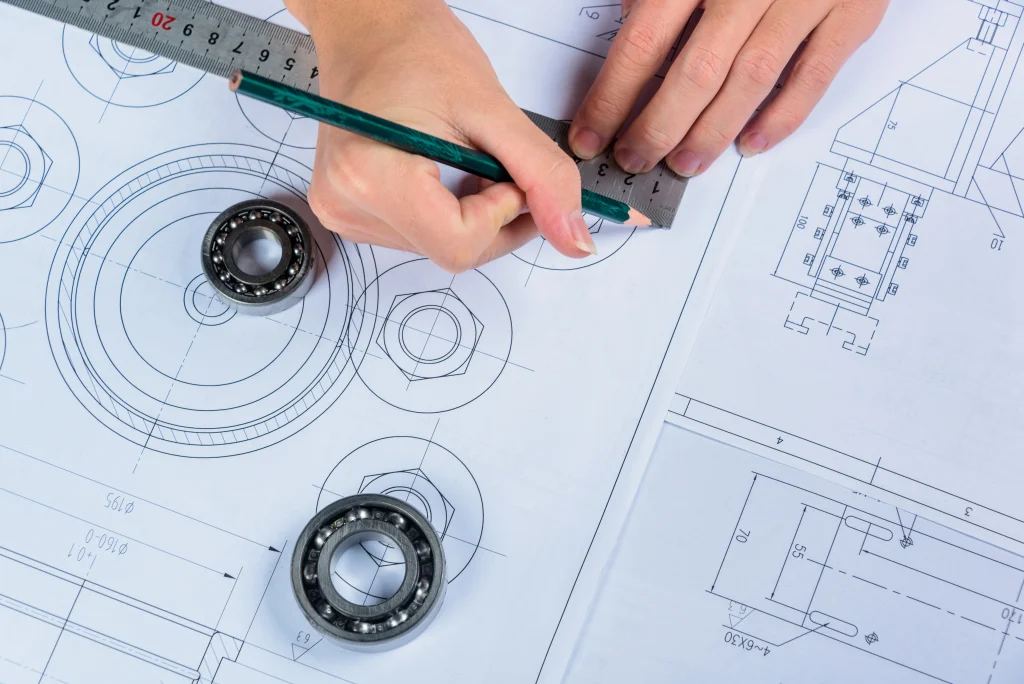
CAD remains deeply rooted in engineering practice because of its versatility and long history. Many engineering professionals are trained extensively in CAD, and countless legacy projects still depend on CAD-based documentation. Engineering firms will continue to use CAD for:
- 2D Drafting – Quick creation of floor plans, elevations, and mechanical layouts.
- Shop Drawings – Manufacturing and fabrication details for components.
- Mechanical and Electrical Detailing – Wiring diagrams, duct layouts, and part specifications.
- Smaller Projects – Where full-scale BIM implementation may not be cost-effective.
CAD is still the go-to solution for precision-focused work or projects with limited budgets.
Why BIM Is Transforming Engineering Services
BIM adoption has been growing rapidly across the globe while CAD continues to serve specific purposes. Many governments and large organizations are making BIM compulsory for public infrastructure projects, which has accelerated its uptake in engineering services. BIM is increasingly preferred because it supports:
- Multidisciplinary Collaboration – All disciplines including structural, mechanical, electrical, and plumbing engineers can work on the same model.
- Clash Detection – Automatic identification of conflicts between ducts, beams, and pipes that reduces costly rework.
- Integrated Data – Quantities, materials, and costs are automatically linked to the model, thus helping with budgeting.
- Lifecycle Management – BIM models support operations and facility management beyond design and construction.
This makes BIM predominantly attractive for large-scale commercial construction projects such as hospitals, airports, industrial facilities, and high-rise developments.
The Dual Role in Modern Engineering Firms
Today, most modern engineering services firms assume hybrid workflow, using CAD and BIM together rather than treating them as competitors. For example:
- CAD might be used for generating precise machine shop drawings.
- BIM could be used for designing as well as coordinating the overall building systems.
- CAD can create fast sketches or client concept drafts.
- BIM can handle the integrated digital twin of the project.
This dual role empowers firms to bring efficiency while respecting client budgets and project timelines.
Global and Local Adoption Trends
Globally, BIM has been strongly adopted in Europe, North America, and parts of Asia, where digital construction mandates and sustainability goals have determined its growth. In contrast, CAD is still dominant in developing markets due to its lower cost and easier learning curve. However, firms aiming to compete internationally are implementing BIM to meet the expectations of global clients.
In local contexts, engineering firms are often requested by clients CAD deliverables because of familiarity, while at the same time, forward-looking developers are asking for BIM models because of their value in long-term asset management. This mixed demand has demanded many firms, including Innovation M Engineering Services to maintain strong capabilities in both systems.
Innovation M Engineering Services Approach
We, at Innovation M Engineering Services, assume a flexible and client-centered approach. We rely on CAD expertise for projects where precision drafting and cost efficiency are the priorities for delivering quick, accurate, and affordable outputs. On the other hand, we employ BIM workflows supported by the latest technology for complex projects that demand collaboration, long-term lifecycle insights, and reduced risk of rework.
This adaptability ensures that clients get advantage from the best of both worlds i.e. traditional reliability and modern innovation. It also makes us a trusted partner for both local developers as well as international clients who have diverse requirements.
The Future of BIM and CAD
Looking ahead, it’s clear that both BIM and CAD will continue to play roles in engineering in the future. CAD remains essential for manufacturing and component-level design. BIM, however, is quickly assuming the status of industry standard for construction and building projects, particularly as more governments and regulatory bodies make BIM mandatory for public projects.
Advancements in AI, cloud computing, and digital twins will further augment BIM’s competences, making it even more central to the way we design and manage built environments.
Choosing the Right Tool for Your Project
So, what you decide whether to use BIM or CAD. The answer relies on the project’s size, complexity, and goals:
- CAD may be the most cost-effective solution for small, straightforward projects.
- BIM is almost always the better choice for large, complex, or commercial projects.
- BIM offers clear advantages by providing a digital record of the building’s systems and components for projects requiring ongoing facility management.
At Innovation M Engineering Services, we help clients in assessing their needs and select the right approach, whether it’s CAD, BIM, or a combination of both.
Conclusion and Call to Action
The debate of BIM vs CAD is not about which tool is universally better, but about understanding which one is right for your project. CAD remains a reliable tool for precision drafting and simple designs, while BIM has become the standard for complex, data-driven, and collaborative construction projects.
At Innovation M Engineering Services, a subsidiary of Innovation M Services, we specialize in providing engineering services that leverage both CAD and BIM to deliver projects with accuracy, efficiency, and innovation. Whether you’re planning a residential development, a commercial tower, or an industrial facility, our experts can guide you in choosing the right tool for your needs.
Contact us today to explore how our expertise in both CAD and BIM engineering services can bring clarity, efficiency, and long-term value to your project.