
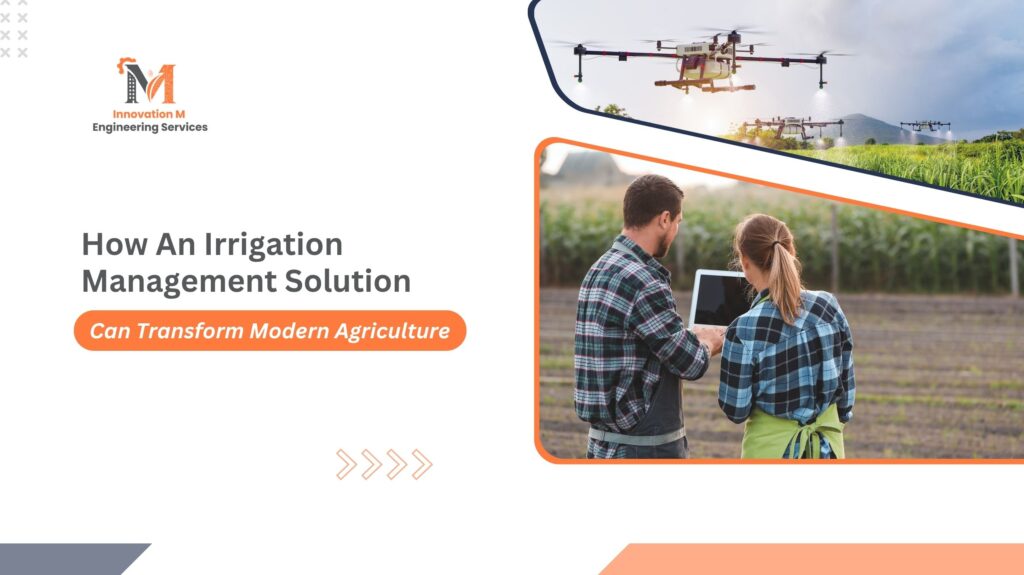
Water is one of the biggest boundaries on modern agriculture. Farmers need higher harvests, but irrigation systems often face water shortage, aging canals, poor monitoring, and uneven distribution. A smart irrigation management solution can help farms, irrigation authorities, and agricultural businesses use water more efficiently. UNESCO’s World Water Development Report notes that agriculture financial records for roughly 70% of global freshwater extractions, which shows why better irrigation planning is now essential.
What Is an Irrigation Management Solution?
An irrigation management solution is a practical system which is used to plan, monitor, control, and improve irrigation water use.
It may include engineering design, canal operation, water scheduling, field-level distribution, sensors, flow monitoring, dashboards, drainage coordination, and data-based decision-making. Organizations that hire construction cost estimators for irrigation and water infrastructure projects can also improve budget planning, resource allocation, and overall project efficiency.
The goal is simple. It helps water managers to deliver the right amount of water at the right time and in the right place.
A Strong System can Support:
- Canal and distributary management
- Farm-level irrigation scheduling
- Flow measurement and control
- Crop water requirement planning
- Drainage and waterlogging monitoring
- Pump operation management
- GIS-based command area mapping
- Water use reporting
- Maintenance planning
For modern agriculture, an irrigation management solution is not only a software tool but it is a complete engineering and management contact.
What is Irrigation Management Software?
What is irrigation management software? It is a digital platform that helps users to schedule, monitor, analyze, and manage irrigation operations.
It can connect field data, canal data, weather information, crop water requirements, and operational records in one platform.
A Typical System May Include:
- Crop water requirement planning
- Irrigation scheduling
- Soil moisture tracking
- Weather-based recommendations
- Pump and energy monitoring
- Flow and water level records
- Farmer or field data
- Mobile alerts
- Dashboard reporting
- Canal performance monitoring
What is irrigation management software? In simple terms, it is the digital film that helps engineers, farmers, and water managers to make better decisions.
However, software alone is not enough. It becomes more useful when supported by strong irrigation engineering services and practical field knowledge.
Why Modern Agriculture Needs Better Irrigation Management
Modern agriculture is under pressure from climate change, population growth, food demand, and water scarcity.
The World Bank states that irrigated agriculture covers about 20% of farmland but produces about 40% of global food. It also notes that global food demand is expected to rise by more than 70% by 2050. This makes smarter agricultural water management, a critical priority.
Many irrigation systems still face serious challenges, such as:
- Canal seepage and conveyance losses
- Uneven water distribution
- Poor field application efficiency
- Aging irrigation infrastructure
- Sedimentation in canals and drains
- Limited real-time monitoring
- High pumping and energy cost
- Drainage failure and waterlogging
- Lack of unfailing operational data
- Weak maintenance planning
These challenges reduce crop productivity and increase water stress.
Farms, irrigation departments, and agricultural businesses can improve their performance by uniting engineering expertise with digital irrigation tools.
Key Features of an Irrigation Management Solution
A reliable irrigation management solution should be designed near the real field conditions. It should help users to manage both infrastructure and water delivery.
Key features may include:
Water Scheduling and Allocation
Helps to plan water delivery based on crop demand, canal capacity, and available supply.
Canal and Distributary Monitoring
Tracks canal flows, water levels, and operational conditions.
Flow Measurement and Control
Supports better regulation of outlets, gates, pumps, and distribution structures.
Soil Moisture Monitoring
Helps to reduce over-irrigation and under-irrigation.
Weather-Based Irrigation planning
Uses rainfall, temperature, humidity, and evapotranspiration data to support irrigation decisions.
Crop Water Requirement Calculation
Helps to estimate how much water need for different crops at different growth stages.
Pump and Energy Management
Supports efficient pump usage and reduces operational cost.
Drainage and Waterlogging Monitoring
Helps to identify areas where excess of water is damaging crops or soil.
GIS-Based Irrigation Mapping
Supports command area mapping, outlet mapping, field boundaries, and infrastructure records.
Mobile Dashboards and Alerts
Helps field teams to receive updates and respond quickly.
These features become stronger when supported by professional irrigation engineering services.
Benefits of an Irrigation Management Solution
A well-planned irrigation management solution can improve water usage, crop production, and infrastructure performance.
Key benefits include:
Better Water use Efficiency
Water is scheduled and delivered based on need, not guesswork.
Reduced Water Losses
Monitoring helps to identify seepage, leakage, overuse, and poor distribution.
Improved Crop Productivity
Crops receive more reliable water at critical growth stages.
Better Canal Operation
Engineers and operators can track flows and improve delivery control.
More Transparent Water Distribution
Records and dashboards help to reduce disputes and improve responsibility.
Lower Pumping and Energy cost
Pumping can be planned more economically.
Better Drought Response
Water managers can focus on supply during low-flow periods.
Improved Drainage Management
Water recording can be monitored and salinity risks may be reduced.
Stronger Reporting
Project owners and agencies can approach better data for planning and review.
Organizations planning irrigation modernization can work with IMES to assess existing systems, find performance gaps, and develop practical engineering-backed solutions.
Role of an Irrigation Engineer in Modern Irrigation Projects
An irrigation engineer plays a key role in making irrigation systems practical, efficient, and sustainable.
The work of an irrigation engineer may include:
- Hydrological analysis
- Hydraulic design
- Canal capacity assessment
- Irrigation scheduling support
- Crop water requirement studies
- Drainage design
- Pumping system review
- Command area development
- Outlet calibration
- Field channel improvement
- Structure inspection
- Construction supervision
- Recovery planning
An experienced irrigation engineer connects field realities with technical design. This is important because irrigation systems must work under changing water supply, crop demand, soil conditions, and climate patterns.
Engineering and Digital Integration in Irrigation Management
Modern irrigation is moving toward a combination of engineering and technology.
This includes sensors, field devices, GIS maps, cloud dashboards, hydraulic models, mobile reporting tools, and decision-support systems.
A digital platform can show data. But engineering judgment explains what the data means.
For example:
- A low flow reading may show canal blockage.
- High field moisture may show over-irrigation.
- Repeated drainage problems may show poor slope or blocked drains.
- Low crop performance may show timing issues in water delivery.
This is why an irrigation management solution should be designed about hydraulic behavior, field layout, canal control, and farming patterns.
Irrigation Infrastructure Rehabilitation and Modernization
Many irrigation systems were built years ago. With the passage of time, their performance declines due to sedimentation, seepage, structure damage, and poor maintenance.
Modernization may involve:
- Canal lining and repair
- Control structure improvement
- Outlet gradation
- Drainage rehabilitation
- Pump station review
- Hydraulic capacity assessment
- Field channel improvement
- Monitoring system installation
- GIS-based asset mapping
- Rehabilitation cost estimation
Irrigation engineering services help project owners to decide what to repair, what to upgrade, and where investment can create the highest value.
FAO has warned that water about affects more than 40% of the world’s people and could affect two-thirds by 2050, largely due to overconsumption of water for food production and agriculture. This makes irrigation modernize for a long-term food security priority.

Project Management for Irrigation Modernization
Irrigation projects need more than design. They also need planning, coordination, cost control, quality assurance, and construction supervision.
Engineering project management solutions help project owners to manage:
- Project scope
- Cost and budget
- Work schedule
- Design coordination
- Earning support
- Contractor performance
- Construction quality
- Risk management
- Reporting and documentation
- Testing and commissioning
- Handover planning
Effective engineering project management solutions reduce delays, improve quality, and keep irrigation modernization associated with technical objectives.
Flexible Engineering Support and Direct Hire Staff
Irrigation modernization projects often need flexible technical teams. A project may require several specialists at different stages.
These may include:
- Irrigation engineers
- Hydraulic modelers
- CAD technicians
- GIS specialists
- Quantity surveyors
- Project planners
- Construction supervisors
- Environmental engineers
- Data analysts
- Monitoring system specialists
Direct hire engineering staff can support long-term design production, site supervision, project reporting, hydraulic reviews, and technical documentation.
Direct hire engineering staff can fill skill gaps without delaying project delivery for project owners, consultants, and contractors.
How IMES Supports Irrigation Management and Modern Agriculture
Innovation M Engineering Services, one of the trusted agricultural engineering firms, supports clients through technical expertise and practical project delivery in agriculture, irrigation, and water infrastructure.
IMES can assist with:
- Irrigation engineering services
- Hydraulic analysis
- Canal rehabilitation planning
- Drainage and water monitoring assessment
- Irrigation system design review
- Digital irrigation concept planning
- GIS and mapping coordination
- Construction supervision support
- Technical documentation
- Cost estimation and BOQ preparation
- Engineering project management solutions
- Direct hire engineering staff
IMES helps clients to connect field challenges with practical engineering solutions. Its team can support both traditional irrigation infrastructure and modern data-driven irrigation systems.
Project owners can contact IMES for technical consultation by observing to improve water delivery, reduce losses, and strengthen agricultural performance.
Future of Irrigation Management
The future of irrigation will be more data-driven, climate-resilient, and efficiency-focused.
Important trends include:
- Smart irrigation systems
- Sensor-based monitoring
- AI-supported water scheduling
- GIS-based water distribution
- Remote canal operation
- Mobile farmer advisory tools
- Digital twins for irrigation networks
- Solar-powered pumping systems
- Data-driven drought management
- Integrated water resources management
As water stress increases, better irrigation planning will become more important for food security, rural livelihoods, and sustainable agriculture.
The future will not depend on software alone. It will depend on the right combination of engineering, field data, water governance, and digital tools also.
Conclusion
An irrigation management solution can convert modern agriculture by improving water use, reducing losses, supporting crop productivity, and strengthening climate resilience.
Better irrigation management helps farmers, irrigation departments, and agricultural businesses make smarter decisions. It also improves planning for restoration, drainage, pumping, and long-term infrastructure performance through effective infrastructure service solutions that support sustainable and efficient water management systems.
Innovation M Engineering Services supports clients with irrigation engineering services, experienced irrigation engineer support, engineering project management solutions, and direct hire engineering staff for irrigation and water infrastructure projects.
Contact IMES today to discuss an irrigation management solution that improves water efficiency, supports better planning, and strengthens agricultural performance.