

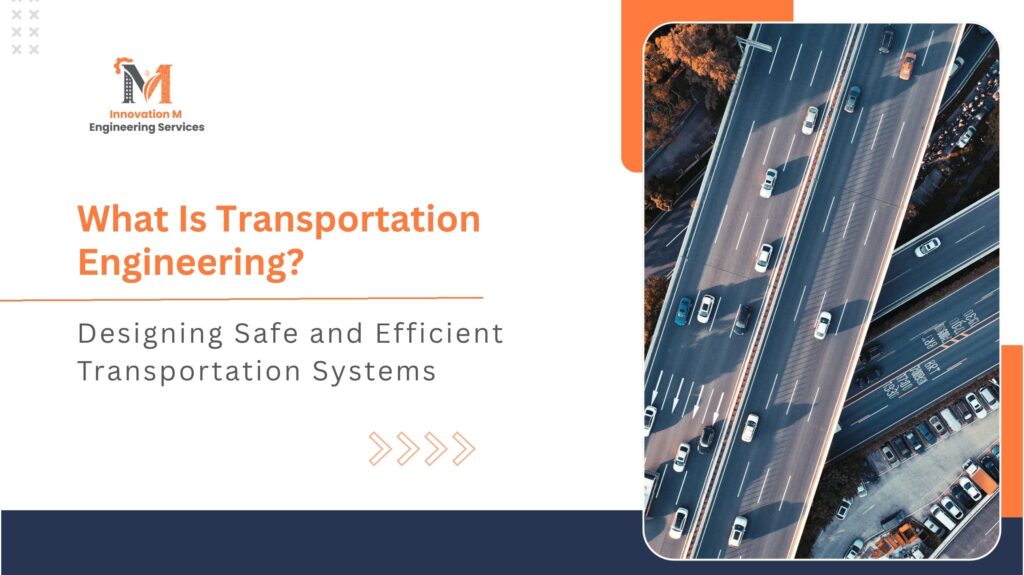
Every city, highway, industrial zone, and rural community depends on transport systems that are safe, efficient, and reliable. Businesses need roads to move goods. People need safe access to schools, hospitals, jobs, and markets. This is why the question what is transportation engineering matters for public agencies, developers, contractors, and infrastructure owners. According to the World Health Organization, safer transport planning is becoming a global priority because road traffic crashes cause about 1.19 million deaths every year.
What is Transportation Engineering?
What is transportation engineering? It is a branch of civil engineering that focuses on the planning, design, operation, maintenance, and improvement of transportation systems.
It covers the movement of people and goods through roads, highways, bridges, intersections, public transport corridors, cargo routes, parking systems, pedestrian paths, and cycling facilities.
Transportation engineering is not only about building roads but it is about creating systems that are safe, practical, efficient, and sustainable.
It helps answer key questions such as:
- How can traffic flow be improved?
- Where should a new road or bridge be located?
- How can accidents be reduced?
- How can public transport become more reliable?
- How can cargo movement become faster?
- How can roads perform better during floods?
- How can cities reduce crowding and releases?
In simple terms, what is transportation engineering can be understood as the science which practices of designing better mobility systems for people, vehicles, shipping, and communities.
Why Transportation Engineering Matters
Transportation systems affect daily life and long-term economic growth. A badly planned road network can create delays, accidents, pollution, and high maintenance costs.
Good transport planning improves safety, access, and productivity.
Professional transportation engineering solutions help to improve:
- Road safety
- Travel time consistency
- Traffic movement
- Shipment and logistics efficiency
- Public transport access
- Pedestrian and cyclist safety
- Land-use connectivity
- Climate flexibility
- Infrastructure life cycle performance
The transport sector is also a major part of global climate discussions. The International Energy Agency reports that global CO₂ emissions from transport rose by more than 250 million masses in 2022 and reached nearly 8 gigatonnes. This shows why efficient and sustainable transport systems matter for both mobility and environmental performance.
In the beginning of project cycle, public agencies, developers, and infrastructure owners can improve mobility outcomes by working with experienced transportation engineering professionals.
Key Areas of Transportation Engineering
Transportation engineering includes several technical fields. Each area supports safer and more efficient movement.
Road and Highway Design
Road and highway design includes orientation, geometry, footpath , drainage, signage, markings, and roadside safety.
Good design increases driver comfort, reduces crash risk, and extends pathway life.
Traffic Engineering
Traffic engineering focuses on how vehicles, people on foot , cyclists, and public transport move through a network.
It includes:
- Traffic count surveys
- Junction analysis
- Signal timing
- Capacity studies
- Parking studies
- Overcrowding management
- Speed control
- Accident blackspot analysis
- Traffic studies to support new developments, road upgrades, and urban improvement projects.
Traffic studies to support new developments, road upgrades, and urban improvement projects are often included by Professional transportation engineering consulting services.
Transport Planning
Future mobility needs are examined by transport planning. It studies how cities, regions, industries, and communities will grow.
Experienced transport planning consultants help agencies and developers to understand future traffic demand, public transport needs, freight movement, and land-use connections.
Public Transport Planning
Bus routes, transit corridors, terminals, stations, stops, and passenger access are focused by Public transport planning.
A good public transport system decreases dependence on private vehicles and improves access for people who do not own cars.
Freight and Logistics Movement
Freight corridors support economic activity. Industrial zones, ports, warehouses, markets, and cities require strong connections.
Transportation engineering helps to plan truck routes, logistics corridors, loading areas, and access roads.
Road Safety Engineering
Road safety engineering focuses on reducing crash risk. It includes safer turnings, pedestrian crossings, school zone safety, visibility improvements, speed calming, signage, and blackspot treatments.
Environmental and Social Planning
Air quality, noise, drainage, land access, and community safety can be affected through Transport projects.
Good engineering solutions consider both mobility and environmental responsibility.

Benefits of Professional transportation engineering solutions
Professional transportation engineering solutions help project owners to reduce risk and to improve long-term performance.
Key benefits include:
- Improved road safety
Better design, signage, markings, and traffic control reduce crash risk. - Reduced congestion
Traffic modeling and junction improvements help to reduce delays. - Better traffic flow
Roads, intersections, and signals can be designed for smoother movement. - Lower vehicle operating costs
Better roads decrease fuel use, tire wear, and travel delays. - Improved access
Good transport systems connect people to jobs, schools, hospitals, and markets. - Better freight movement
Strong freight corridors support businesses, logistics, and trade. - More reliable public transport
Proper planning develops routes, stops, and passenger movement. - Stronger climate resilience
Better drainage and flood-resilient design protect roads during extreme weather. - Longer infrastructure life
Sound pavement, drainage, and maintenance planning reduce future renovation costs.
Organizations planning roads, highways, traffic systems, or mobility corridors can work with IMES to assess needs, identify design gaps, and develop practical engineering-backed solutions.
Role of Transport Planning Consultants
Before the beginning of major infrastructure investment, Transport planning consultants support decision-making.
They help project owners to study:
- Existing traffic patterns
- Future mobility demand
- Land-use growth
- Parking needs
- Public transport routes
- Freight movement
- Pedestrian and cyclist access
- Corridor development
- Transport impact evaluations
- Multi-modal mobility options
Good transport planning consultants use data, field surveys, traffic models, and engineering judgment. Their work helps to ensure that roads and transport systems are not overdesigned, underdesigned, or badly connected.
This is important for both urban and rural projects. A new commercial development may need a traffic impact study. A highway improvement may need demand forecasting. A public transport corridor may need passenger flow analysis.
Transportation Engineering Consulting Services for Infrastructure Projects
Transportation engineering consulting services support projects from early planning to detailed design and construction.
These services may include:
- Feasibility studies
- Traffic impact assessments
- Road and highway design
- Junction improvement plans
- Pavement healing design
- Road safety audits
- Drainage and flood- resistant road planning
- Construction supervision support
- Cost estimation and BOQ preparation
- Technical documentation
- Project scheduling and reporting
Strong transportation engineering consulting services reduce insecurity. They help clients to select the right design, manage risks, improve safety, and avoid cost related mistakes during implementation.
For public agencies, they support better planning and investment decisions. For developers, they help to secure agreements and improve site access. For contractors, they support smoother execution and technical conformity.
Modern Tools Used in Transportation Engineering
Transportation engineering now uses data and digital tools more than ever. agreements
Modern tools may include:
- GIS mapping
- Traffic modeling software
- Drone surveys
- Remote sensing
- Road safety audit tools
- Pavement management systems
- Digital terrain models
- Smart traffic signals
- Intelligent transport systems
- Real-time traffic monitoring
- AI-assisted traffic analysis
These tools improve accuracy. They help engineers to be aware of traffic movement, road condition, terrain, drainage, and safety risks.
However, digital tools cannot replace professional judgment. Good engineers still need to interpret data, review site conditions, and design practical solutions.
Transportation Engineering and Road Safety
Road safety is one of the most important goals of transportation engineering.
Road design affects driver behavior. It also affects pedestrian safety, traffic speed, visibility, drainage, and crash severity.
Safety-focused design may include:
- Safer junction layouts
- Clear signs and road markings
- Pedestrian crossings
- Traffic calming measures
- Improved lighting
- School zone safety
- Shoulder and roadside protection
- Better road drainage
- Blackspot treatment
- Safe bus stop locations
The WHO has stated that road traffic deaths remain a serious global safety issue.Weak road users facing significant risk. This makes safer road planning and design essential for modern transport systems.
Sustainable and Climate-Resilient Transportation Systems
Modern transportation engineering should address sustainability and climate risk.
Roads and bridges are exposed during floods, heat, storms, and drainage failures. Poor design can increase maintenance costs and unsettle communities.
Sustainable transportation engineering solutions may include:
- Flood-resilient road design
- Better stormwater drainage
- Public transport priority
- Walking and cycling infrastructure
- Sustainable pavement materials
- Electric vehicle charging corridors
- Reduced congestion emissions
- Climate-sensitive route planning
- Environmental impact improvement
Efficient transport planning can also reduce unnecessary travel delays. This supports lesser fuel use, better air quality, and improved economic productivity.
Flexible Engineering Support for Transportation Projects
Transportation projects often need different specialists at different stages.
A project may require:
- Transportation engineers
- Highway design engineers
- Traffic engineers
- CAD technicians
- GIS specialists
- Road safety experts
- Quantity surveyors
- Project planners
- Construction supervisors
- Environmental engineers
Engineering staff augmentation services help clients to gage technical teams during design peaks, urgent submissions, traffic studies, and construction support.
This model is useful when a project needs fast technical capacity without long staffing delays.
Clients may also use direct hire engineering staff for long-term workloads. These staff members can support road design, CAD documentation, traffic analysis, project management, supervision, reporting, and technical reviews.
For transport projects with tight time limit, engineering staff augmentation services and direct hire engineering staff can help to maintain delivery motion.
How IMES Supports Transportation Engineering Projects
Innovation M Engineering Services helps clients with practical transportation and infrastructure engineering expertise.
IMES can help with:
- Transportation engineering consulting services
- Road and highway design support
- Traffic and mobility studies
- Transport planning support
- Pavement and drainage review
- Road safety support
- GIS and CAD documentation
- Technical reporting
- Construction supervision support
- Project coordination
- Flexible engineering teams
- Engineering staff augmentation services
- Direct hire engineering staff
IMES focuses on practical engineering support that helps clients to improve safety, reduce design gaps, and boost project delivery.
Clients can contact IMES to discuss transportation engineering support for roads, highways, traffic systems, infrastructure development, and mobility planning projects.
Future of Transportation Engineering
The future of transportation engineering will be shaped by smart mobility, digital data, climate resistance, and safer design.
Key trends include:
- Intelligent transport systems
- AI-supported traffic management
- Digital twins for road networks
- Connected vehicle infrastructure
- Electric vehicle charging corridors
- Transit-oriented development
- Complete streets planning
- Climate- resistant roads
- Sustainable pavement systems
- Data-driven road safety management
Future transport systems will need stronger combination between engineering, planning, technology, environment, and public safety.
This means project owners will need experienced engineers, better data, and flexible technical support.
Conclusion
To conclude we see what transportation engineering helps project owners, developers, contractors, and public agencies and why transport planning is central to safe and efficient mobility.
Transportation engineering improves road safety, traffic flow, public access,cargo movement, infrastructure performance, and sustainable development.
Innovation M Engineering Services supports clients with transportation engineering consulting services, transportation engineering solutions, transport planning consultants, flexible project support, engineering staff augmentation services, direct hire engineering staff, and the ability to hire GIS developers for mapping, spatial analysis, and geospatial data management. Our experienced professionals help organizations strengthen project delivery, improve planning accuracy, and meet evolving infrastructure and transportation requirements.
Contact IMES today to discuss transportation engineering support that improves safety, mobility, and long-term infrastructure performance.